
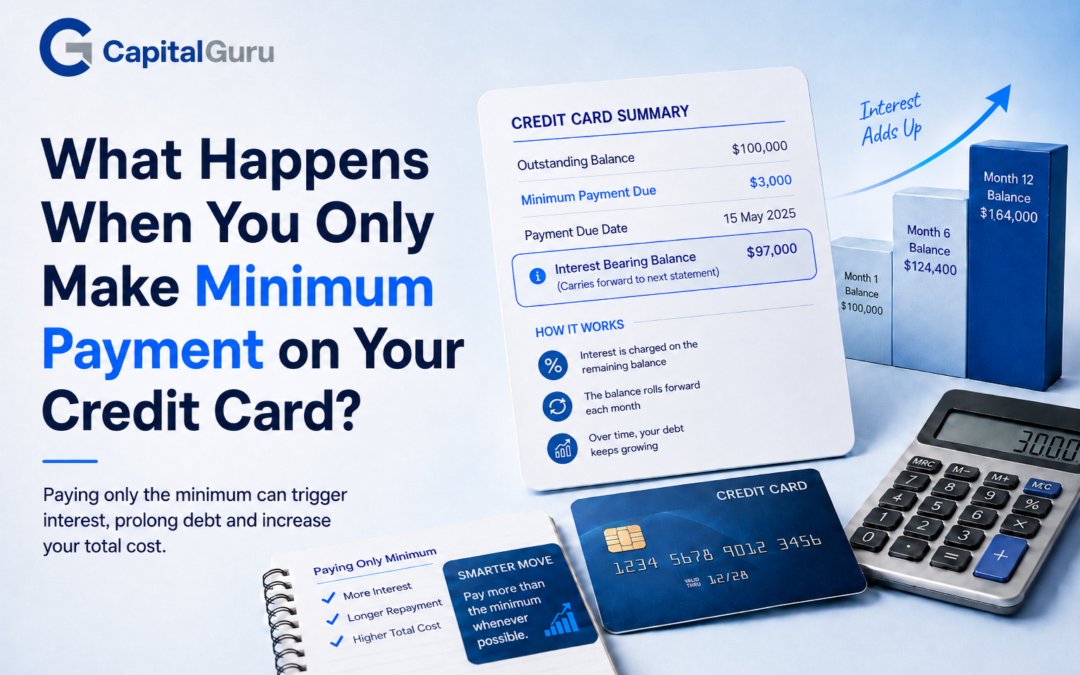
Paying the Minimum Is Not the Same as Clearing Your Debt
In Part 1, we looked at what happens when you close a credit card.
But many cardholders choose another path.
They keep the account open and make only the minimum payment on their credit card every month.
The payment is made before the due date, so the immediate minimum repayment requirement is satisfied.
However:
Making the minimum payment keeps you servicing the debt. It does not mean you are clearing the debt.
The unpaid amount continues as revolving credit and can become part of your interest-bearing balance.
How Does Credit Card Minimum Payment Work?
Suppose your statement shows:
Total outstanding: S$10,000
Minimum payment: S$300
You pay S$300.
The remaining S$9,700 does not disappear.
It continues as revolving debt and can attract interest.
This creates a distinction between:
Making the required payment
and
Repaying the debt.
How Is Interest Charged?
Credit-card interest rates in Singapore are commonly around 25% to 29% per annum, depending on the issuer and product.
Using a simplified example:
| Amount | |
|---|---|
| Credit card balance | S$10,000 |
| Minimum payment | S$300 |
| Balance carried forward | S$9,700 |
| Illustrative rate | 27.8% p.a. |
Approximate 30-day interest:
S$9,700 × 27.8% ÷ 365 × 30 ≈ S$222
So your S$9,700 balance could effectively move towards:
S$9,922
before considering new spending and the bank’s actual interest calculation.
You paid S$300, but after another month’s approximate interest, the debt effectively fell by only around S$78 in this simplified illustration.
That’s why minimum payments can be deceptive.
What Is an Interest-Bearing Balance?
This becomes particularly important when looking at your credit position.
When credit-card spending is fully repaid according to the applicable terms, it does not become revolving interest-bearing debt.
When the balance is not fully repaid and is carried forward, the amount accruing interest contributes to your interest-bearing unsecured balance.
For example:
| Position | Amount |
|---|---|
| Statement balance | S$10,000 |
| Payment | S$300 |
| Balance carried forward | S$9,700 |
| Interest-bearing balance | Approx. S$9,700* |
*Simplified illustration; actual calculations and reporting depend on the financial institution.
You can therefore have:
No missed payment
while simultaneously having:
A substantial interest-bearing balance.
No late payment does not mean no revolving debt.
Why Does This Matter to a Lender?
There are two different questions:
1. Are you making your required payments on time?
2. How much interest-bearing debt are you carrying?
Consider:
| Borrower A | Borrower B | |
|---|---|---|
| Credit limit | S$20,000 | S$20,000 |
| Outstanding | S$1,000 | S$18,000 |
| Utilisation | 5% | 90% |
| Missed payments | None | None |
Neither borrower has necessarily missed a required payment.
Yet Borrower B is carrying significantly more revolving debt.
This is why “I’ve never missed a payment” does not necessarily describe someone’s entire credit position.
The Minimum Payment Trap
A S$10,000 debt may not feel like a S$10,000 obligation when this month’s requested payment is only S$300.
The borrower stops asking:
“Can I repay S$10,000?”
and starts asking:
“Can I afford S$300 this month?”
The problem becomes worse if new spending continues.
Interest is added, the minimum payment is made, more purchases are charged and the remaining balance rolls forward.
The card gradually changes from a payment tool into a borrowing facility.
When Does This Become Financial Distress?
The important question is:
Is your interest-bearing balance increasing or decreasing?
A temporary revolving balance may be manageable if there is a realistic repayment plan.
Warning signs include:
- Balances remaining consistently high
- Outstanding debt increasing monthly
- Most available credit being utilised
- Multiple cards carrying balances
- New spending continuing despite existing debt
- Increasing income being used to service interest
At this stage, minimum payments may keep the accounts current without solving the underlying problem.
The progression can eventually become:
Full payment → Minimum payment → Growing interest-bearing balance → Financial stress → Late payment → Default
What If the Debt Has Already Accumulated?
This brings us to Part 3.
What happens when the borrower already has S$50,000, S$80,000 or more of revolving credit-card debt?
For someone who owns a private property with sufficient equity, another option may exist.
Instead of continuing to carry expensive unsecured revolving debt, the borrower may explore whether property equity can be used to restructure the accumulated debt.
That is the subject of Part 3: How to Clear Credit Card Debt Using Your Private Property.