
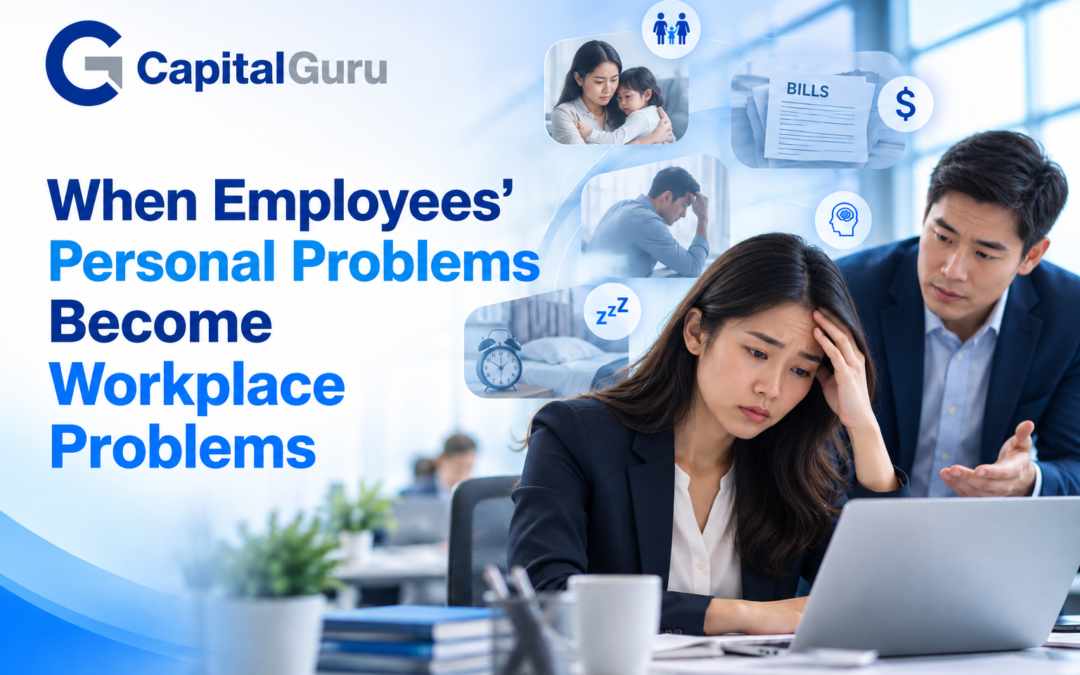
Every employee has a life outside work, and employee personal problems do not simply disappear when they arrive at the office door.
Family conflict, financial stress, relationship difficulties, caregiving responsibilities, health concerns and emotional challenges can all affect how a person performs at work.
Sooner or later, these issues may show up through absenteeism, lateness, poor concentration, lower productivity, mistakes, mood changes or conflict with colleagues.
For employers, this creates a difficult question:
How much responsibility should a company take when an employee’s personal problems start affecting the workplace?
The answer requires a balance between compassion, fairness and accountability.
When Employee Personal Problems Become Business Problems
An employee may be facing a genuine difficulty that has nothing to do with the company.
However, once that difficulty begins affecting attendance, performance, customers or colleagues, management has to respond.
This is especially important in smaller businesses where individual employee takes on significant responsibilities.
When one employee is frequently absent or unable to perform consistently, the work usually does not disappear. Another colleague may have to take over the client, complete the task, cover the shift or absorb the additional workload.
What started as a personal issue can therefore become an operational problem for the business.
It can also affect morale. If the same employees repeatedly have to compensate for someone else, they may eventually feel that the situation is unfair.
That is why employers need to manage the impact, even when they are sympathetic to the cause.
Understand the Situation Before Judging
A sudden decline in performance does not always mean that an employee has become lazy, careless or disengaged.
Managers should therefore try to understand the circumstances before making assumptions.
A private conversation may reveal that the employee is dealing with a family emergency, financial difficulty, caregiving responsibilities or another temporary problem.
In some situations, reasonable short-term support can make a meaningful difference.
This could include:
- Emergency leave
- Temporary workload adjustments
- Reasonable flexibility around appointments
- Changes to non-critical responsibilities
- Short-term flexible work arrangements where practical
Singapore’s Ministry of Manpower has also highlighted the importance of workplace support for employees’ needs beyond work, including caregiving, and its Tripartite Advisory recommends that employers review workplace practices that support employee well-being.
Employers can refer to MOM’s Tripartite Advisory on Mental Health and Well-being at Workplaces for additional guidance.
Employee Personal Problems Still Need Boundaries
Understanding an employee’s situation does not mean that every personal issue should automatically become the company’s responsibility.
If an employee repeatedly arrives late, misses work, fails to complete tasks or requires colleagues to continuously cover for them, management eventually has to address the impact.
Otherwise, the burden simply shifts from one employee to the rest of the team, creating resentment, reduces morale and affecting productivity.
The objective is therefore not to choose between compassion and discipline.
Good management requires both.
An employee should know that the company is willing to provide reasonable support, but they should also understand that attendance, conduct and performance standards still matter.
Financial Problems Are a Common Example
Financial stress is a good example of how a personal issue can gradually become a workplace issue.
An employee struggling with debt or household expenses may become distracted, anxious or less productive.
They may also begin requesting salary advances or other forms of financial assistance.
A company may choose to help during a genuine emergency.
However, repeatedly solving the immediate financial problem does not necessarily solve the underlying issue.
If an employee consistently spends more than they earn or has accumulated unsustainable debt, repeated advances may simply delay the problem.
The same principle applies to many other personal challenges.
Temporary support can help someone through a crisis. Indefinite support can create dependency.
Employers therefore need to distinguish between helping someone through a difficult period and taking responsibility for repeatedly solving the same problem.
Create a Clear Framework for Employee Personal Problems
Companies do not necessarily need a complicated policy.
What they need is a consistent approach.
1. Understand What Is Happening
Speak with the employee privately.
The objective is not to investigate every detail of their personal life. It is to understand enough to identify the impact on work and determine whether temporary support is appropriate.
2. Provide Reasonable Short-Term Support
Where appropriate, the company may provide temporary flexibility or assistance.
The arrangement should reflect the circumstances as well as the operational needs of the business.
3. Set Clear Expectations
Support should not mean that all expectations disappear.
The employee should still understand what is required during the support period.
This could include:
- Minimum attendance requirements
- Communication when absent
- Client responsibilities
- Important deadlines
- Basic performance expectations
4. Set a Review Date
Avoid leaving temporary arrangements open-ended.
Agree on a reasonable review date so management and the employee can assess whether the situation has improved.
5. Address Ongoing Performance Issues
If the personal problem continues to affect attendance, performance or conduct after reasonable support has been provided, the company may need to manage the matter through its normal HR or performance processes.
That does not mean the employer lacks compassion.
It means the company also has responsibilities to customers, shareholders and other employees.
Fairness to the Rest of the Team Matters
One of the most difficult aspects of employee personal problems is their impact on colleagues.
Employers may focus heavily on helping the person going through difficulties while overlooking those who are carrying the additional workload.
If one employee receives repeated exceptions, colleagues may eventually ask:
“Why am I expected to meet the normal standard when someone else is not?”
That perception can damage trust in management.
Different employees may require different forms of support, but the principles should remain consistent:
- Understand the circumstances
- Provide reasonable support
- Maintain clear expectations
- Review the arrangement
- Address continuing problems fairly
This reduces the risk that compassion is interpreted as favouritism.
Managers Are Not Expected to Solve Everything
Managers should be supportive, but they are not counsellors, financial advisers or social workers.
Sometimes the most appropriate form of support is helping the employee reach the right professional resource.
Depending on the situation, this could include:
- Professional counselling
- Financial counselling
- Medical support
- Legal advice
- Family or social support services
MOM’s workplace well-being guidance also encourages employers to create referral pathways and provide access to appropriate professional support where possible.
The employer’s primary role is to manage the workplace impact while providing reasonable support.
Protect the Employee’s Privacy
Personal difficulties often involve sensitive information.
Managers therefore need to handle conversations carefully.
The company generally does not need to know every detail of an employee’s circumstances.
Management only needs enough information to understand how the situation affects work and what temporary adjustments may be reasonable.
Information should also be shared only with people who genuinely need to know.
This helps protect the employee’s dignity and maintains trust.
Compassion and Accountability Can Coexist
Employees are human beings, not machines.
There will be periods when people need understanding and flexibility.
At the same time, a company also has responsibilities to its customers, shareholders and the rest of the team.
The company may not have caused the employee’s personal problem, but it still has to manage the consequences when that problem enters the workplace.
A healthy workplace therefore sends a clear message:
We will support our people through difficult periods, but support and accountability must coexist.
That balance is healthier for the employee, the team and the business.
The CapitalGuru View
For SMEs, people management is often more personal because teams are smaller and relationships are closer.
That can be a strength.
But it can also make boundaries harder to maintain.
The best approach is not to become cold or overly rigid.
It is to be clear.
Understand the employee’s situation.
Provide reasonable support.
Set expectations.
Agree on a review period.
And if employee personal problems continue to affect attendance, performance or the rest of the team, address the impact fairly and consistently.
Compassion matters.
So does accountability.
Strong businesses need both.