
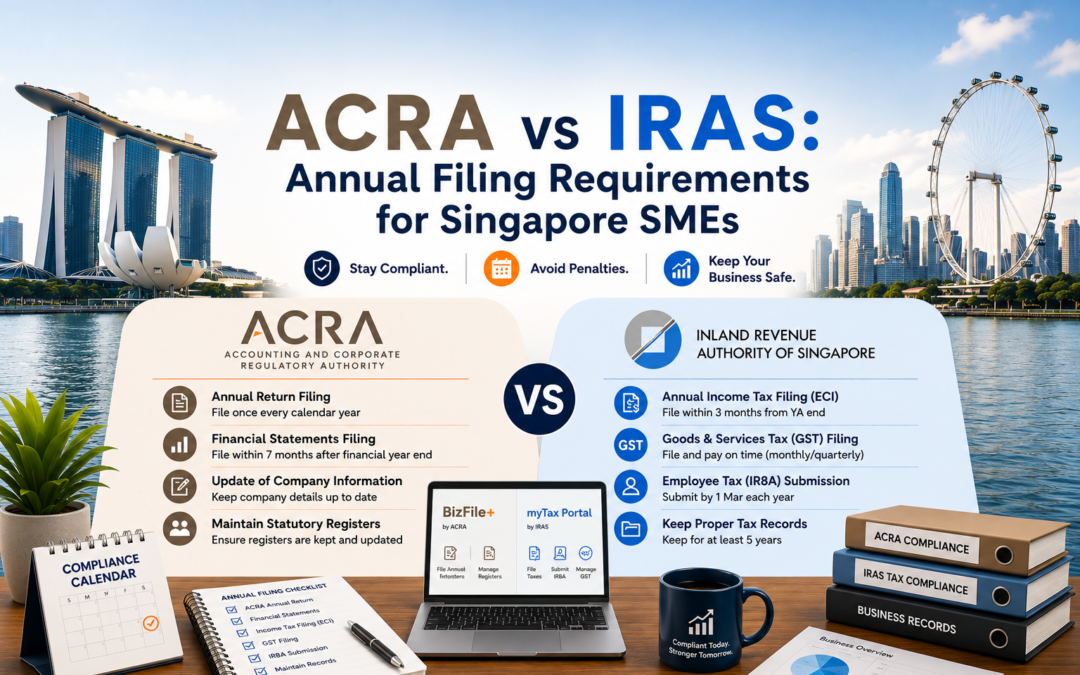
Running a business in Singapore involves more than managing sales, operations and cashflow. Every company is also required to fulfil annual statutory obligations to government agencies, and two of the most important are ACRA Annual Return filing and IRAS Corporate Income Tax filing.
Many SME owners mistakenly assume these are the same filing. Others believe that if the company made little or no profit, there is no need to submit anything.
In reality, ACRA and IRAS have different purposes, different filing requirements and different deadlines.
More importantly, maintaining timely compliance demonstrates good corporate governance, which can strengthen your credibility with banks, investors and financing providers.
What Is ACRA?
The Accounting and Corporate Regulatory Authority (ACRA) regulates companies incorporated in Singapore.
Its role is to ensure companies comply with the Companies Act and maintain accurate corporate records.
Every year, companies are generally required to file an Annual Return with ACRA.
This filing keeps the company’s statutory information up to date and allows ACRA to maintain an accurate register of Singapore companies.
The Annual Return typically includes:
- Company particulars
- Directors
- Shareholders
- Registered office address
- Principal business activities
- Financial statements (where applicable)
- Confirmation of Annual General Meeting (AGM) or AGM exemption
Think of the Annual Return as updating your company’s legal and statutory records.
What Is IRAS?
The Inland Revenue Authority of Singapore (IRAS) administers Singapore’s tax system.
Unlike ACRA, IRAS focuses on taxation rather than corporate governance.
Companies are generally required to submit their annual corporate income tax filings so IRAS can determine whether tax is payable.
Depending on the company, annual tax filing may include:
- Estimated Chargeable Income (ECI)
- Form C-S (Lite)
- Form C-S
- Form C
- Tax computations
- Financial statements (where required)
Think of IRAS filing as reporting your company’s taxable income.
ACRA vs IRAS: What’s the Difference?
| ACRA Annual Return | IRAS Annual Filing |
|---|---|
| Filed with ACRA | Filed with IRAS |
| Focuses on company compliance under the Companies Act | Focuses on corporate income tax |
| Updates company information | Reports taxable income |
| Confirms directors, shareholders and registered office | Determines tax payable |
| May include financial statements where applicable | Includes ECI and Form C-S, Form C-S (Lite) or Form C |
Although both filings use the company’s financial information, they serve entirely different purposes.
When Are the Filing Deadlines?
One of the most common questions business owners ask is:
“When do I need to file?”
The answer depends on your company’s Financial Year End (FYE).
ACRA Annual Return
For most private limited companies, the Annual Return must generally be filed within 7 months after the company’s Financial Year End (FYE).
Example
| Financial Year End | ACRA Annual Return Due |
|---|---|
| 31 December 2025 | 31 July 2026 |
| 31 March 2026 | 31 October 2026 |
| 30 June 2026 | 31 January 2027 |
IRAS Annual Filing
Corporate income tax filing consists of two separate submissions.
1. Estimated Chargeable Income (ECI)
Companies that are required to file ECI must generally do so within 3 months after their Financial Year End.
Some companies may qualify for an ECI filing waiver if they meet IRAS exemption criteria.
Example
| Financial Year End | ECI Due Date |
|---|---|
| 31 December 2025 | 31 March 2026 |
| 31 March 2026 | 30 June 2026 |
2. Corporate Income Tax Return
Companies are also required to file their annual Corporate Income Tax Return using the appropriate form:
- Form C-S (Lite)
- Form C-S
- Form C
The annual corporate tax return must generally be submitted by:
- 30 November (paper filing)
- 15 December (e-Filing)
Unlike the ACRA Annual Return, this deadline is tied to the Year of Assessment (YA) rather than simply counting months from the Financial Year End.
Do Companies Still Need to File if They Made No Profit?
One of the biggest misconceptions among SME owners is that companies do not need to file if they have not generated profit.
This is not necessarily true.
A company may still need to fulfil its statutory obligations even if:
- It incurred a loss.
- It has minimal business activity.
- No corporate income tax is payable.
- It is temporarily inactive.
The applicable filing requirements depend on the company’s circumstances and eligibility under ACRA and IRAS regulations.
What Happens if You File Late?
Late filing can result in financial penalties and regulatory enforcement.
ACRA
Late filing of the Annual Return may result in:
- S$300 late filing penalty if filed up to 3 months after the deadline.
- S$600 late filing penalty if filed more than 3 months after the deadline.
Persistent non-compliance may also lead to:
- Court prosecution
- Director disqualification or debarment
- Striking off the company
- Other enforcement actions
IRAS
Failure to submit corporate income tax returns on time may result in:
- Estimated tax assessments
- Late filing penalties or composition amounts
- Court action for persistent non-compliance
- Additional enforcement measures
Ignoring filing obligations can become significantly more costly than filing on time.
Why Compliance Matters Beyond Avoiding Penalties
Many business owners view annual filings as purely administrative tasks.
However, timely compliance also demonstrates that a company has sound corporate governance and financial discipline.
When assessing financing applications, banks and financial institutions commonly review:
- ACRA records
- IRAS compliance
- Financial statements
- Corporate governance practices
- Regulatory compliance history
A company with consistent and timely filings generally presents a lower compliance risk than one with repeated late submissions.
Although late filing does not automatically result in a loan rejection, a history of poor compliance may raise additional questions during the credit assessment process.
How Good Governance Builds Lender Confidence
When businesses apply for financing, lenders evaluate more than profitability.
They also assess whether the company is well managed.
Examples include:
- Timely statutory filings
- Up-to-date financial statements
- Proper accounting records
- Tax compliance
- Corporate governance
- Regulatory compliance
These factors help lenders gain confidence in the company’s management and its ability to meet future financial obligations.
Good governance therefore supports not only regulatory compliance but also improves a company’s credibility when applying for business financing.
Best Practices for SME Owners
To avoid unnecessary penalties and strengthen your company’s governance:
- Maintain proper accounting records throughout the year.
- Keep track of statutory filing deadlines.
- Prepare financial statements early.
- Work closely with your accountant and corporate secretary.
- Review your compliance status annually.
- Do not wait until the filing deadline to gather supporting documents.
Treat annual filing as part of your overall corporate governance rather than simply an administrative obligation.
Final Thoughts
Although both ACRA and IRAS require annual submissions, they serve very different purposes.
ACRA focuses on maintaining accurate corporate records and ensuring compliance with the Companies Act, while IRAS focuses on assessing a company’s corporate income tax obligations.
Understanding the distinction helps businesses remain compliant, avoid unnecessary penalties and build stronger corporate governance.
For SMEs seeking financing, timely compliance sends an important message to lenders—it demonstrates that the business is organised, responsible and committed to meeting its statutory obligations.
Good governance is not just about avoiding fines. It is about building trust with regulators, banks, investors and business partners, laying a stronger foundation for long-term business growth.