
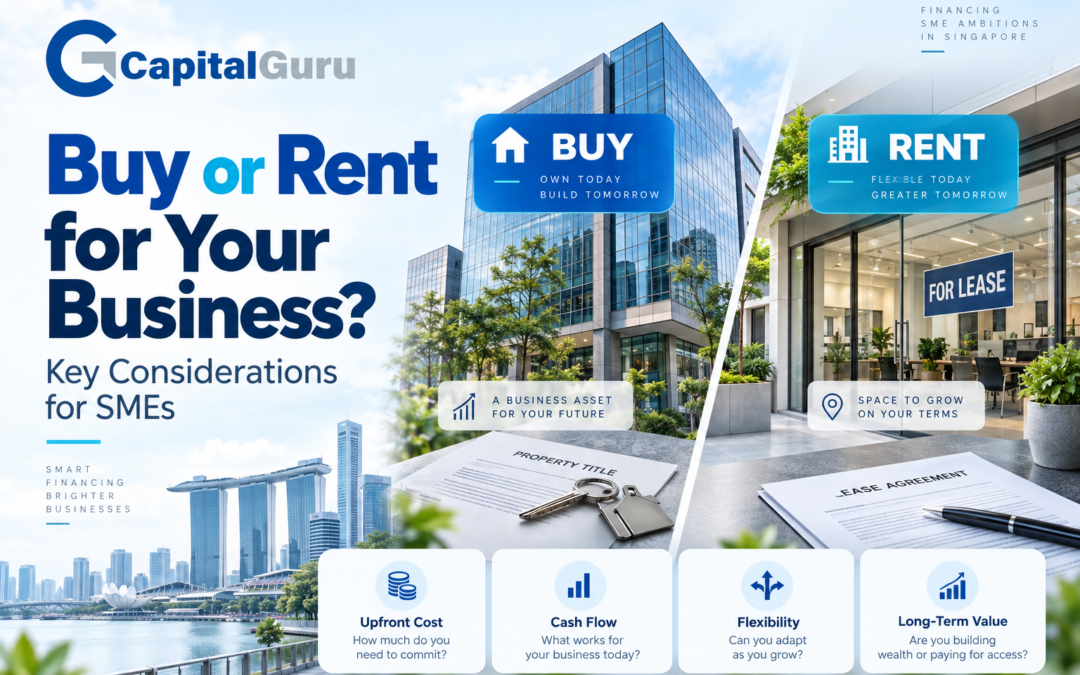
When an SME needs a warehouse, office, showroom or factory, one of the biggest decisions is whether to buy or rent for your business.
There is no universal answer.
For some businesses, renting provides flexibility and preserves working capital. For others, owning the premises can provide greater stability, build equity and create an asset that may later support additional financing.
The right decision depends on more than comparing monthly rent against a mortgage instalment.
Business owners should also consider cashflow, future expansion, property tenure, relocation costs and how much capital they are prepared to commit to the property.
This is Part 1 of CapitalGuru’s 3-Part SME Property Financing Series.
How Much Cash Can the Business Afford to Commit?
For most SMEs, cashflow remains one of the biggest considerations.
Renting normally requires less upfront capital. Apart from the security deposit and initial costs of taking over the premises, the business can preserve more cash for:
- Inventory
- Payroll
- Supplier payments
- Marketing
- Expansion
- Unexpected business expenses
Buying requires significantly more upfront capital.
Even where the bank provides a high financing quantum, the business may still need to fund the equity portion of the purchase together with stamp duty, legal fees and other acquisition costs.
The question is therefore not simply:
“Can the company afford the downpayment?”
It should also be:
“How much cash will the business still have after buying the property?”
A business can become asset-rich but cash-poor if too much working capital is tied up in property.
Flexibility or Long-Term Stability?
Renting offers flexibility.
This can be valuable for businesses that are:
- Growing quickly
- Still testing a location
- Unsure about future space requirements
- Likely to relocate
- Operating in an industry where business needs can change rapidly
If the business outgrows the premises, it can move when the lease expires.
Property ownership offers a different advantage: stability.
The business has greater certainty over where it will operate and is less exposed to future rental increases or the landlord deciding not to renew the lease.
For an established business that expects to remain in the same location for many years, buying may therefore become more attractive.
Consider the Cost of Moving
Renting provides flexibility, but relocating a business may be more expensive than it first appears.
At the end of a tenancy, businesses may face:
- Reinstatement costs
- Renovation of the new premises
- Relocation expenses
- Operational downtime
- Costs associated with moving machinery or equipment
For businesses with highly customised premises, heavy machinery or specialised infrastructure, these costs can be substantial.
If a company expects to occupy the same type of premises for many years, repeatedly paying to renovate, reinstate and relocate can change the economics of renting.
In some cases, the amount spent on repeated relocations could potentially have been directed towards the equity required to purchase a property instead.
Buying Allows the Business to Build Equity
One important difference between renting and buying is what happens to the money over time.
Rent is a recurring operating expense.
Mortgage repayments, on the other hand, gradually reduce the outstanding loan and increase the owner’s equity in the property.
If the property appreciates, the business owner may also benefit from the increase in value.
However, appreciation should never be assumed.
Commercial and industrial property prices can rise or fall depending on market conditions, property type, location, remaining lease and demand.
The decision to purchase should therefore still make business sense even without relying on future capital gains.
Ownership Can Create Future Financing Options
A property is not only a place from which the business operates.
Once sufficient equity has been built up, it may also become a financing asset.
Depending on the property value, outstanding loan and lender’s credit assessment, the owner may potentially use the property in future to obtain:
- An Equity Term Loan
- Additional working capital
- Refinancing
- Property-backed business financing
This can give a mature SME another source of liquidity.
However, additional borrowing against the property also increases leverage, so the purpose of the funds and repayment capacity remain important.
Buying Gives Greater Control Over the Premises
Ownership generally provides greater control over how the premises are used, subject to applicable regulations and property restrictions.
This may matter for businesses that require:
- Specialised layouts
- Significant renovation
- Fixed machinery
- Warehousing systems
- Long-term operational infrastructure
A tenant may need the landlord’s approval for significant changes and could eventually have to reinstate the premises.
An owner has more certainty that investments made into the premises can continue to support the business over a longer period.
But Property Ownership Also Creates Commitments
Buying should not be seen as automatically superior to renting.
Ownership comes with its own financial obligations.
Apart from the property loan, businesses should consider ongoing costs such as:
- Property tax
- MCST maintenance fees, where applicable
- Repairs and upkeep
- Insurance
- Financing costs
The business also becomes less flexible.
If the premises become too small, too large or unsuitable for operations, selling or leasing out the property is more complicated than simply moving when a tenancy expires.
Think About the Opportunity Cost of Capital
This is particularly important for SMEs.
Suppose a company has S$500,000 available.
That money could potentially be used as equity towards purchasing a property.
But the same S$500,000 could also be used to:
- Expand the business
- Purchase inventory
- Hire more employees
- Acquire another company
- Invest in equipment
- Strengthen the company’s cash reserves
The property therefore competes with other uses of capital.
If the core business can generate a much stronger return from that capital, renting and reinvesting the cash into the business may make more sense.
On the other hand, a mature company with stable cashflow and excess liquidity may find property ownership more attractive.
Look at the Property’s Remaining Lease
For leasehold commercial and industrial properties, the remaining lease should also form part of the decision.
A shorter remaining lease may affect:
- Future resale demand
- Property valuation
- Financing availability
- Maximum loan tenure
- Long-term usefulness of the property
An SME planning to occupy the premises for the next 15 or 20 years should therefore consider whether the property’s remaining lease supports that plan.
A property may appear affordable precisely because its lease is shorter.
The purchase price alone does not tell the whole story.
So, Should Your Business Buy or Rent?
There is no simple formula.
Renting may make more sense when:
- The business is still growing rapidly
- Future space requirements are uncertain
- Preserving working capital is a priority
- The business expects to relocate
- Capital can generate a better return within the operating business
Buying may make more sense when:
- The business is established and financially stable
- The premises will be required for many years
- Relocation would be costly or disruptive
- The company has sufficient liquidity after the purchase
- Ownership supports the company’s long-term strategy
The correct decision should therefore be based on the business itself rather than simply on whether property prices are attractive.
Key Takeaway
The question is not simply:
“Is buying cheaper than renting?”
A better question is:
“Which option puts the business in a stronger position over the next five to ten years?”
For one SME, that may mean preserving cash and renting.
For another, it may mean securing its own premises and gradually building property equity.
Once the decision to buy has been made, the next challenge is structuring the financing correctly.
In Part 2: SME Property Loan: What to Check Before Buying, we look at financing quantum, LTV, valuation, upfront costs, loan tenure and the important loan conditions SMEs should understand before committing to a property purchase.