
For homeowners carrying substantial personal debt, un-locking property equity through refinancing appears to be the obvious solution.
Here is the catch, the very debt they are trying to clear can also prevent them from qualifying for refinancing.
That was the situation faced by one CapitalGuru client.
The client owned a private residential property and wanted to refinance her existing housing loan while releasing additional equity from the property. However, mounting personal debt had pushed her monthly debt obligations beyond the 55% Total Debt Servicing Ratio, or TDSR, threshold.
This meant conventional refinancing was not immediately available.
Rather than simply submitting the same case to more banks, CapitalGuru developed a structured Credit Repair strategy to first improve the client’s debt position and then reopen the path to lower-cost property financing.
The strategy was:
Short-term bridging finance → reduce unsecured debt → improve CBS profile → improve debt servicing position → refinance property → raise equity term loan → repay the bridging facility
The objective was not to make the debt disappear.
It was to restructure the client’s liabilities into a more manageable form.
The Problem: Personal Debt Was Blocking Refinancing
The client’s Credit Bureau Singapore profile showed substantial unsecured borrowing.
Her earlier CBS profile reflected approximately:
S$106,012 in interest-bearing unsecured balances
and around:
S$3,862 in monthly unsecured instalments
These commitments had a major impact on her debt servicing position.
The client therefore faced a chicken or egg problem.
She had equity in her private property that could potentially be used to restructure the debt, but the high level of personal debt prevented her from qualifying for the property refinancing needed to access that equity.
This was where Credit Repair became relevant.
The problem could not simply be solved by searching for another bank.
The underlying debt position needed to improve first.
What Credit Repair Means in This Case
The term Credit Repair can sometimes be misunderstood.
In this case, it did not mean hiding liabilities, disputing legitimate debts or trying to manipulate the client’s credit report.
It meant improving the borrower’s actual financial position.
The focus was on:
- Reducing outstanding unsecured debt
- Lowering monthly repayment commitments
- Improving the client’s CBS profile
- Strengthening the TDSR position
- Creating a more sustainable refinancing structure
The improvement had to come from real changes to the debt position.
Only then would the client have a realistic chance of qualifying for conventional bank refinancing.
Stage 1: Short-Term Bridging Finance
CapitalGuru first assisted the client with a short-term bridging facility.
The purpose of the bridge was very specific.
It was used to clear or substantially reduce the personal debt that was affecting the client’s ability to refinance.
This was not intended to be a permanent financing arrangement.
The bridge was simply the first stage in the overall Credit Repair plan.
Most importantly, there was a clear exit strategy from the beginning.
If the client’s unsecured debt could be reduced sufficiently and her affordability improved, the next step would be to refinance the property and use the longer-term bank facility to close the bridging loan.
Without that exit plan, the bridge could have simply created another layer of debt.
A Significant Improvement in the CBS Profile
Over the following months, the client’s credit position improved substantially.
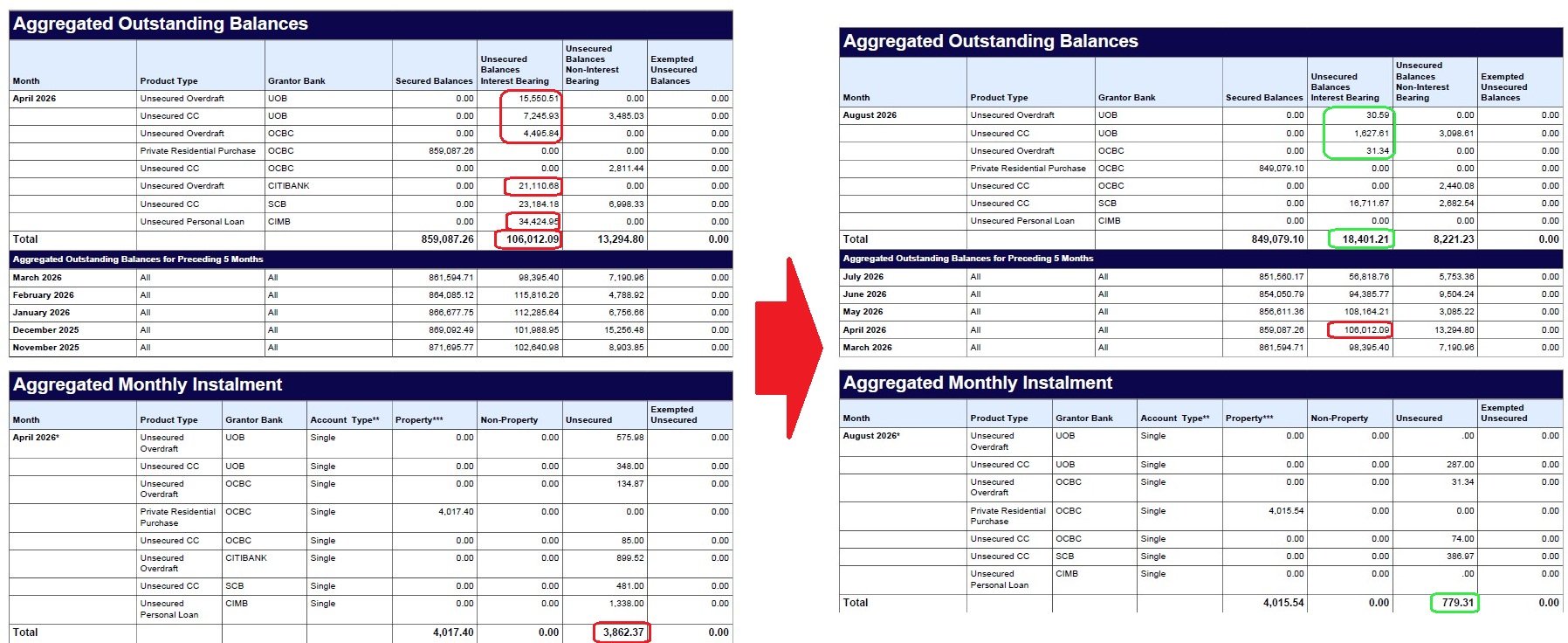
Her interest-bearing unsecured balances reduced from approximately:
S$106,012 to S$18,401
That is a reduction of approximately:
S$87,611, or about 83%.
Her aggregated monthly unsecured instalments also fell from approximately:
S$3,862 to S$779 per month
This represented a reduction of more than:
S$3,000 per month.
| CBS position | Earlier profile | Later profile |
|---|---|---|
| Interest-bearing unsecured balances | S$106,012 | S$18,401 |
| Monthly unsecured instalments | S$3,862 | S$779 |
| Reduction in unsecured balances | ~83% | |
| Reduction in monthly unsecured commitments | ~80% |
This was an important turning point.
The client did not simply have a better-looking credit report.
Her actual monthly debt burden had materially reduced.
That directly improved her overall affordability position.
Why Monthly Debt Commitments Matter
Many borrowers focus primarily on how much debt they owe.
Banks also look at how much of the borrower’s monthly income is required to service that debt.
A borrower may have an acceptable income but still struggle to qualify for property financing because too much of that income is already committed to:
- Credit cards
- Personal loans
- Overdrafts
- Car loans
- Existing housing loans
- Other recurring liabilities
That is why reducing monthly debt commitments was central to this Credit Repair strategy.
Stage 2: Property Refinancing
Once the client’s unsecured debt had been materially reduced, CapitalGuru revisited the property refinancing.
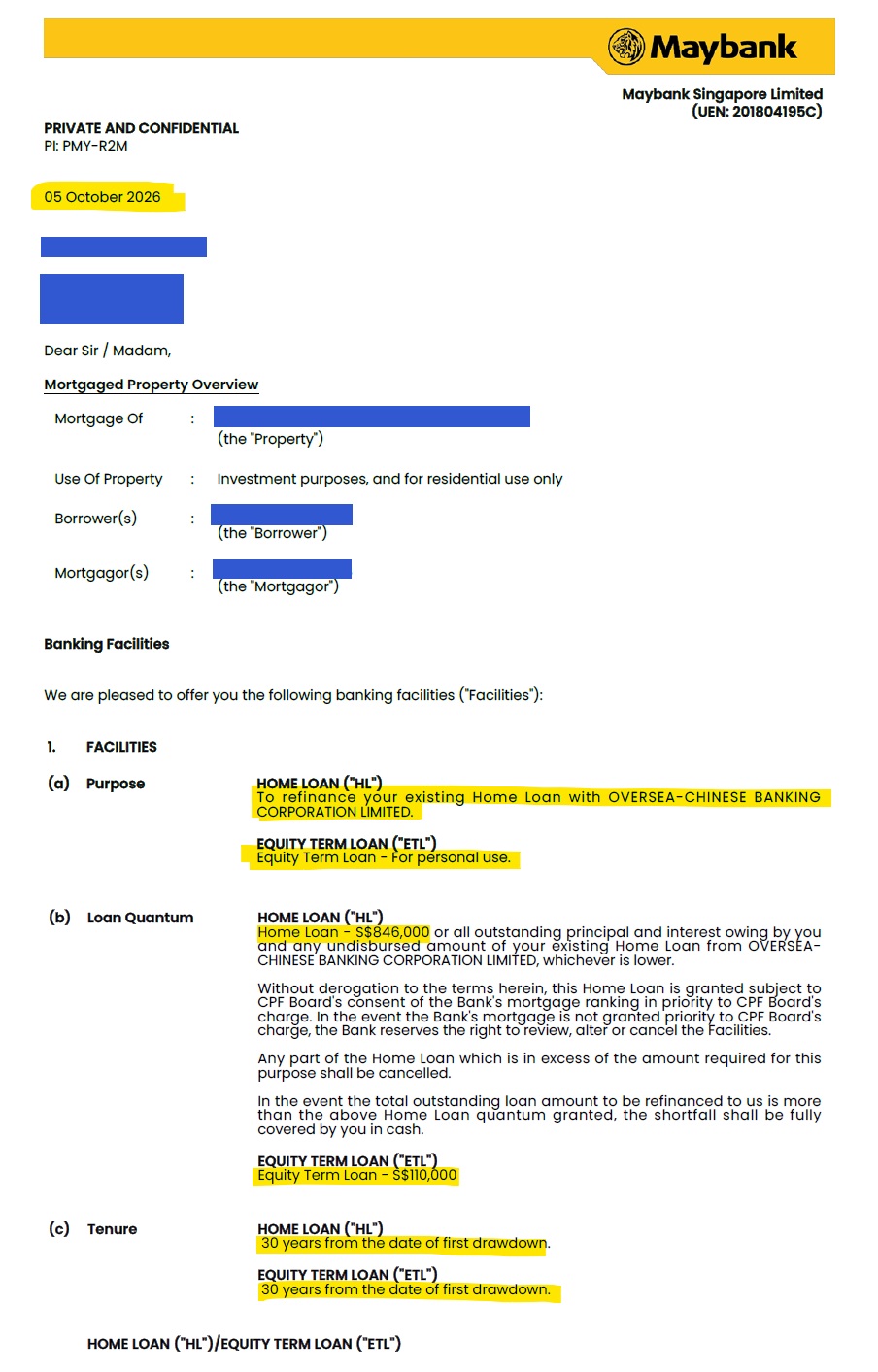
The client subsequently secured a new bank Letter of Offer comprising:
Home Loan: S$846,000
Equity Term Loan: S$110,000
Tenure: 30 years
The home loan was used to refinance the existing housing facility.
The S$110,000 equity term loan allowed the client to release additional equity from the property.
This completed the second stage of the plan.
The client had moved from being unable to refinance because of excessive personal debt to securing both mortgage refinancing and an additional equity term facility.
Closing the Loop
The additional property-backed financing also provided a clear exit for the temporary bridging facility.
That completed the restructuring cycle:
Personal debt → bridging finance → Credit Repair → improved CBS profile → property refinancing → equity term loan → repayment of bridge
This sequence is important.
A short-term bridging loan can be expensive and should not become a permanent solution.
Its usefulness comes from having a clear and achievable exit.
In this case, the bridge created time and space for the client’s debt profile to improve sufficiently for conventional bank refinancing.
The Debt Was Restructured, Not Erased
It is important to be clear about what happened.
The client’s liabilities did not simply disappear.
They were restructured.
A substantial amount of high-cost unsecured borrowing was reduced, while part of the overall debt burden was shifted into longer-term property-backed bank financing.
This can potentially lower financing costs and improve monthly cashflow.
But there is also an important trade-off.
Property-backed borrowing is secured against the homeowner’s property.
Repayment discipline therefore becomes even more important.
The purpose of the exercise should be to create a path towards less debt over time, not simply additional borrowing capacity.
The Biggest Risk After Credit Repair
One of the biggest dangers after a successful restructuring is returning to the same borrowing habits.
If a client clears credit cards, improves the CBS profile and successfully refinances the property, but then begins building up unsecured debt again, the financial position may become even worse.
The borrower could eventually have:
A larger property loan + new credit card debt + new personal loans
That defeats the purpose of the restructuring.
A successful Credit Repair exercise should therefore be followed by financial discipline.
The objective should be:
Reduce financing cost → improve cashflow → keep unsecured debt low → gradually reduce total liabilities
The CapitalGuru View
This case demonstrates that Credit Repair is more than just waiting for a credit score to improve and requires active intervention.
For this client, the problem was a Catch 22:
She needed property refinancing to reduce expensive personal debt, but the personal debt prevented her from qualifying for property refinancing.
CapitalGuru helped break that cycle by structuring the process in stages.
The outcome included:
- Interest-bearing unsecured balances reduced by approximately 83%
- Monthly unsecured instalments reduced by more than S$3,000
- A materially improved CBS profile
- Successful refinancing of the existing housing loan
- S$110,000 equity term loan approved
- A clear exit for the temporary bridging facility
The key lesson is simple:
Credit Repair should improve the borrower’s real financial position, not merely the appearance of the credit report.
At CapitalGuru, our role goes beyond submitting applications.
We look at what is preventing approval, determine what can realistically be improved, and structure a path towards a more sustainable financing position.
Case details have been generalised and personal information removed to protect client confidentiality. Financing eligibility, TDSR assessment, property valuation, loan quantum and equity term facilities remain subject to lender assessment and prevailing regulations. Bridging finance carries additional risks and should only be considered where there is a credible repayment or refinancing strategy.