
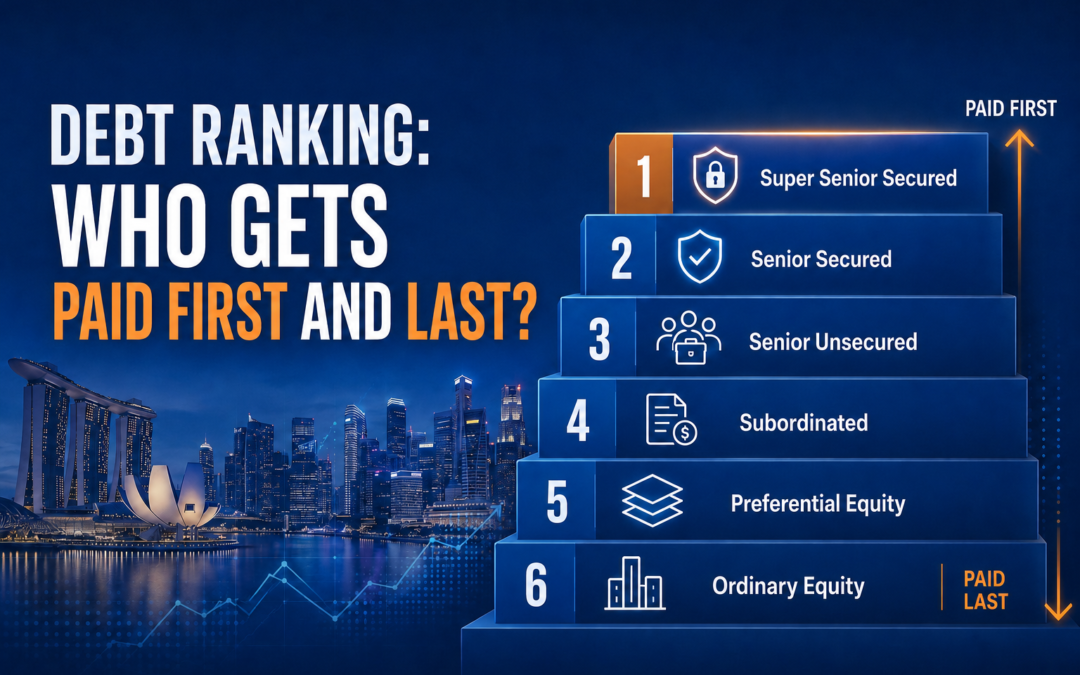
Who gets paid first?
The answer depends on debt ranking, also known as the priority of claims or capital structure hierarchy.
Not all creditors stand on equal footing. Some lenders have first priority over specific assets, while others may recover only a fraction of what they are owed—or nothing at all.
Whether you are a business owner, investor or lender, understanding debt ranking helps explain why certain loans carry lower interest rates than others, why banks require security and how financing is structured in the corporate world.
What is Debt Ranking?
Debt ranking refers to the legal order in which creditors are repaid if a borrower enters liquidation, judicial management or corporate restructuring.
Because a distressed company often does not have sufficient assets to repay every creditor in full, the law and contractual agreements determine who gets repaid first.
Generally speaking:
- Higher-ranking debt carries lower credit risk.
- Lower-ranking debt carries higher credit risk.
- Higher risk typically commands higher interest rates or expected returns.
Debt ranking is determined by several factors, including:
- Security documents
- Loan agreements
- Intercreditor agreements
- Subordination agreements
- Applicable insolvency laws
Why Debt Ranking Matters
Every lender evaluates where they sit within the capital structure before approving financing.
A bank holding a first-ranking mortgage over a property has a much greater likelihood of recovering its money than a lender providing an unsecured loan.
As a result, debt ranking directly influences:
- Loan approval
- Interest rates
- Maximum loan quantum
- Security requirements
- Financing flexibility
Understanding this hierarchy also allows businesses to structure their borrowings more strategically and avoid unnecessarily restricting future financing options.
The Debt Ranking Hierarchy
1. Super Senior Secured Debt
At the very top of the capital structure is Super Senior Secured Debt.
These creditors enjoy repayment priority over all other financial creditors.
Examples include:
- Debtor-in-Possession (DIP) financing
- Court-approved rescue financing
- Super-priority revolving credit facilities
- Certain restructuring loans granted super-priority status
Because these facilities rank ahead of every other lender, they generally carry the lowest level of credit risk.
2. Senior Secured Debt
Senior secured debt represents the majority of traditional bank financing.
These lenders hold legally enforceable security over identifiable assets.
Examples include:
- Commercial property loans
- Industrial property mortgages
- Residential mortgages
- Equipment financing
- Inventory financing
- Trade finance secured by receivables
- Debentures with fixed and floating charges
If the borrower defaults, senior secured lenders have the first legal claim over the secured assets.
This explains why secured financing generally offers:
- Lower interest rates
- Higher borrowing limits
- Longer repayment tenures
than unsecured borrowing.
3. Senior Unsecured Debt
Senior unsecured creditors do not hold specific collateral over company assets.
However, they still rank ahead of subordinated creditors.
Examples include:
- Unsecured working capital loans
- Corporate bonds
- Certain unsecured bank term loans
- General unsecured trade facilities
Recovery depends on how much value remains after secured creditors have been repaid.
4. Subordinated Debt (Junior Debt)
Subordinated debt ranks behind all senior creditors.
The lender agrees, through a contractual subordination agreement, that senior lenders will be repaid first.
Examples include:
- Shareholder loans
- Mezzanine financing
- Junior bonds
- Vendor financing
- Certain private credit facilities
Because repayment only occurs after all senior creditors have been satisfied, subordinated debt carries greater credit risk.
To compensate for this additional risk, subordinated financing typically commands:
- Higher interest rates
- Higher investment returns
- Greater downside risk
Subordinated financing is commonly used to bridge the funding gap between senior debt and equity.
5. Preferred Equity
Preferred equity sits between debt and ordinary equity.
Preferred shareholders may enjoy:
- Fixed preferred dividends
- Liquidation preference over ordinary shareholders
- Priority over common equity
However, preferred equity remains junior to every category of debt.
6. Ordinary Equity (Common Shareholders)
Ordinary shareholders rank last.
As the owners of the business, shareholders enjoy unlimited upside if the company performs well.
However, they are also the last to receive any proceeds if the company fails.
Shareholders only receive any remaining assets after:
- Super Senior Secured creditors
- Senior Secured creditors
- Senior Unsecured creditors
- Subordinated creditors
- Preferred shareholders
have all been fully repaid.
In most insolvency situations, shareholders recover little or nothing.
Debt Ranking Summary
| Ranking | Financing Type | Typical Examples |
|---|---|---|
| 1 | Super Senior Secured | DIP financing, rescue financing, super-priority revolving facilities |
| 2 | Senior Secured | Mortgages, property loans, equipment finance, secured trade finance |
| 3 | Senior Unsecured | Unsecured bank loans, corporate bonds, unsecured working capital |
| 4 | Subordinated (Junior) Debt | Mezzanine financing, shareholder loans, junior notes |
| 5 | Preferred Equity | Preference shares |
| 6 | Ordinary Equity | Common shareholders |
Understanding Pari Passu
One of the most common legal terms found in loan agreements, bond documentation and syndicated lending is pari passu.
Derived from Latin, pari passu means “on equal footing” or “with equal step.”
Rather than representing another level in the debt hierarchy, pari passu describes how creditors within the same ranking are treated.
When two or more creditors rank pari passu, they have equal legal priority and share recoveries proportionately. No creditor within that class has priority over another unless otherwise agreed under an intercreditor agreement.
For example, two banks each provide a S$5 million Senior Unsecured Loan to the same company.
If only S$6 million remains available for Senior Unsecured creditors after higher-ranking creditors have been repaid, the proceeds are distributed proportionately.
| Creditor | Amount Owed | Recovery |
|---|---|---|
| Bank A | S$5 million | S$3 million |
| Bank B | S$5 million | S$3 million |
Each lender recovers 60% of its outstanding loan because both creditors rank pari passu.
The same principle may also apply to Senior Secured lenders. For example, in a syndicated loan, several banks may share the same security package and rank pari passu, with recoveries distributed proportionately among them.
This differs from subordinated debt, where one lender contractually agrees to rank behind another and receives repayment only after senior creditors have been paid in full.
In simple terms:
- Debt ranking determines which class of creditors gets paid first.
- Pari passu determines how creditors within the same class share recoveries.
A Practical Example
Imagine a company owns assets worth S$10 million and has the following obligations:
| Debt Type | Outstanding |
|---|---|
| Super Senior Secured | S$1.0 million |
| Senior Secured | S$5.0 million |
| Senior Unsecured (Pari Passu) | S$2.0 million |
| Subordinated Debt | S$1.5 million |
| Ordinary Equity | S$3.0 million |
If the company is liquidated and only S$7 million is realised, the repayment waterfall would generally be:
- Super Senior Secured creditors receive S$1.0 million in full.
- Senior Secured creditors receive S$5.0 million in full.
- Senior Unsecured creditors share the remaining S$1.0 million on a pari passu basis according to the amount each is owed.
- Subordinated creditors receive nothing.
- Ordinary shareholders receive nothing.
This illustrates why lenders pay close attention to where they rank before extending credit. A stronger position in the capital structure generally translates into a higher likelihood of recovery if the borrower defaults.
Why This Matters for SMEs
Many SMEs rely on multiple financing facilities throughout their growth journey, including:
- Working Capital Loans
- Trade Financing
- Invoice Financing
- Commercial and Industrial Property Loans
- Equipment Financing
- Enterprise Financing Scheme (EFS) facilities
Each additional borrowing changes the company’s capital structure.
Before approving a loan, lenders typically assess:
- Existing secured borrowings
- Available collateral
- Whether another lender already holds first-ranking security
- Cash flow and debt servicing ability
- Recovery prospects in a default scenario
The higher a lender ranks within the capital structure, the lower its credit risk. This often enables lenders to offer larger loan amounts, more competitive interest rates and longer repayment terms.
Does Enterprise Singapore’s Risk-Sharing Change Debt Ranking?
A common misconception is that the Enterprise Financing Scheme (EFS) changes a lender’s legal priority.
It does not.
Enterprise Singapore’s risk-sharing arrangement simply shares part of the lender’s credit loss if the borrower defaults.
It does not change the lender’s legal ranking against other creditors or alter its security position.
The repayment waterfall continues to be determined by the loan documentation, security arrangements and applicable insolvency laws.
Key Takeaways
Debt ranking is one of the most fundamental concepts in corporate finance.
It influences:
- Lending decisions
- Interest rates
- Financing structures
- Credit risk
- Recovery prospects
Understanding where each creditor sits within the capital structure helps businesses structure financing more effectively while allowing lenders to assess risk more accurately.
Simply put:
- The higher you rank, the lower your credit risk.
- The lower you rank, the higher your expected return—but also the greater your risk of loss.
Understanding these concepts enables businesses to negotiate financing more strategically and appreciate why lenders place such importance on security, collateral and creditor priority.
How CapitalGuru Can Help
At CapitalGuru, we help SMEs structure financing strategically—not just by securing funding, but by understanding how different financing facilities fit within a company’s overall capital structure.
Whether you’re seeking working capital, trade finance, commercial property financing or expansion capital, having the right debt structure today can improve your financing flexibility and borrowing capacity in the future.