
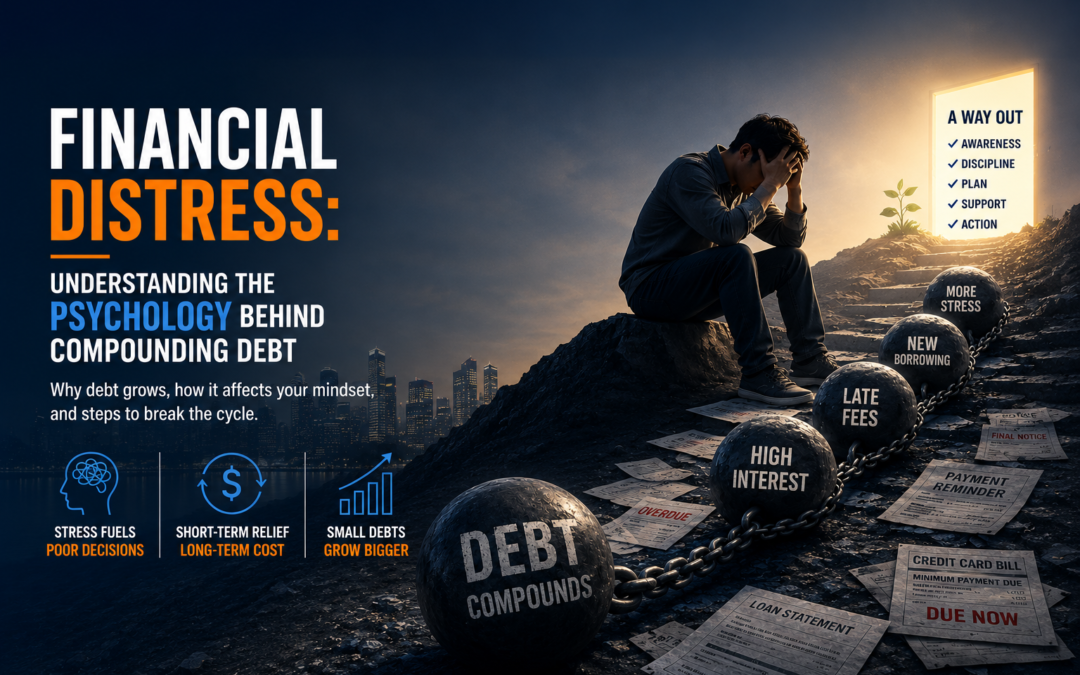
However, debt itself is rarely the root cause.
More often than not, financial distress begins with deteriorating cash flow, followed by a series of short-term decisions that gradually make the financial situation worse.
One of the biggest misconceptions is that when someone experiencing financial distress receives money, their first priority is to repay their outstanding loans.
In reality, this is often not what happens.
Whether it’s a salary, bonus, tax refund or proceeds from selling an asset, many financially distressed individuals first use the money to meet immediate living expenses rather than repay their lenders.
To an outsider, this may appear irresponsible.
However, financial distress fundamentally changes how people think. Instead of planning for the future, every decision becomes focused on surviving today.
Ironically, this survival mindset is often what causes debts to compound.
Financial Distress vs Financial Gap
Before discussing why debts compound, it is important to distinguish between financial distress and a financial gap.
Although both involve a shortage of cash, they are fundamentally different.
What is a Financial Gap?
A financial gap is a temporary mismatch between when money is needed and when money is expected to be received.
The borrower has a clear and realistic source of repayment but needs short-term financing to bridge the timing difference.
Examples include:
- Waiting for salary to be credited.
- Waiting for a customer to pay an invoice.
- Waiting for project progress payments.
- Waiting for the completion of a property sale.
- Waiting for CPF proceeds or investment maturity.
In these situations, the borrower is generally financially healthy. The problem is one of timing rather than affordability.
With the appropriate financing solution, a financial gap can usually be resolved without creating long-term financial problems.
What is Financial Distress?
Financial distress is fundamentally different.
The problem is no longer about timing.
Instead, the borrower lacks sufficient income or cash flow to meet existing financial obligations on a sustainable basis.
Unlike a financial gap, there is no clear repayment event on the horizon.
Even when additional funds are received, they are often consumed by other urgent commitments before existing debts can be reduced.
Examples include:
- Living expenses consistently exceeding income.
- Borrowing to repay existing loans.
- Repeatedly missing loan repayments.
- Constantly relying on credit cards.
- Taking new loans simply to stay afloat.
Financial distress is therefore not merely a cash shortage.
It is a situation where the underlying financial position has become unsustainable.
Why the Difference Matters
Identifying whether someone is facing a financial gap or financial distress is one of the first steps in recommending the appropriate financing solution.
A borrower experiencing a financial gap may benefit from:
- Bridging loans.
- Invoice financing.
- Working capital facilities.
- Temporary overdrafts.
- Trade financing.
A borrower experiencing financial distress may instead require:
- Debt restructuring.
- Refinancing.
- Repayment rescheduling.
- Asset disposal.
- Cash flow restructuring.
Using short-term financing to solve long-term financial distress often worsens the situation by increasing debt without addressing the underlying problem.
In our next article, we will explore financial gaps in greater detail, why they are a normal part of personal and business finance, and how suitable financing can bridge temporary cash flow mismatches without creating unnecessary long-term debt.
Financial Distress Changes Decision-Making
When finances are healthy, people generally make decisions with long-term objectives in mind.
They save consistently, invest for the future and repay debts according to schedule.
However, once financial distress sets in, priorities change dramatically.
The focus shifts from:
“How can I improve my financial future?”
to
“How do I get through today?”
Every dollar becomes precious.
Every expense feels urgent.
Long-term financial planning is replaced by immediate survival.
Behavioural economists refer to this as a scarcity mindset, where financial pressure narrows a person’s attention to today’s urgent problems while pushing future consequences into the background.
Why Loan Repayments Often Become a Lower Priority
One observation frequently made by lenders is that borrowers experiencing financial distress often do not repay their loans immediately, even after receiving money.
This is not necessarily because they have no intention of paying.
Rather, they are trying to manage multiple urgent obligations simultaneously.
Their priorities often become:
- Mortgage or rent.
- Food and groceries.
- Utility bills.
- Children’s education.
- Transportation.
- Medical expenses.
- Family commitments.
- Loan repayments.
From their perspective:
- Paying rent keeps a roof over the family’s head.
- Buying groceries ensures the family has food.
- Paying utility bills keeps the electricity running.
By comparison, delaying a loan repayment may appear less urgent because the consequences are often delayed.
Many borrowers genuinely believe:
“I’ll repay the loan after I’ve settled these urgent expenses.”
Unfortunately, there is almost always another urgent expense waiting.
The Illusion of Temporary Relief
Receiving money often creates a false sense of financial recovery.
After settling the most pressing bills, borrowers feel temporary relief.
However, because loan repayments have been postponed:
- Interest continues to accrue.
- Late payment charges may apply.
- Outstanding balances continue to grow.
By the following month, the borrower faces both a new set of living expenses and a larger debt burden.
What began as a temporary delay slowly becomes a recurring pattern.
How Debt Begins to Compound
Many people believe debt compounds purely because of interest.
Interest is only part of the problem.
Debt also compounds because financial distress changes behaviour.
When repayments are repeatedly delayed:
- Interest accumulates.
- Late payment fees increase.
- Credit profiles deteriorate.
- Borrowing becomes more expensive.
- Financing options become more limited.
Some borrowers eventually take on new loans simply to service existing ones.
Each step makes financial recovery increasingly difficult.
The issue is no longer just the amount owed.
It becomes the growing cost of carrying the debt.
Stress Creates Reactive Decisions
Financial pressure also affects judgement.
Instead of making strategic financial decisions, distressed individuals often become reactive.
Common behaviours include:
- Paying whoever is demanding payment the loudest.
- Ignoring lenders because they fear difficult conversations.
- Borrowing from one lender to repay another.
- Using credit cards to fund daily living expenses.
- Taking high-interest loans without considering the long-term consequences.
Each decision may solve today’s problem.
Collectively, however, they often create a much larger problem tomorrow.
Why Early Communication Matters
One of the biggest mistakes borrowers make is avoiding their lenders.
Many assume that if they cannot make a repayment, there is little point contacting the bank or financial institution.
In reality, early communication often creates more options.
Depending on the circumstances, lenders may consider:
- Loan restructuring.
- Extended repayment tenures.
- Refinancing.
- Temporary repayment arrangements.
These discussions are generally much easier before repayments have become significantly overdue.
Waiting until every available dollar has been exhausted usually leaves far fewer solutions available.
Breaking the Cycle of Financial Distress
Recovering from financial distress requires more than simply earning a higher income.
It also requires changing financial behaviour.
Some practical steps include:
- Preparing a realistic monthly budget.
- Distinguishing between urgent and important expenses.
- Prioritising high-interest debts.
- Avoiding unnecessary borrowing.
- Seeking financial advice early.
- Communicating openly with lenders when repayment difficulties arise.
Small changes made early are often far more effective than drastic measures taken later.
A Change in Mindset
One of the biggest lessons about financial distress is that the greatest challenge is often psychological rather than mathematical.
The amount of debt may not change overnight.
The way a person thinks does.
Instead of planning for long-term financial recovery, they become focused solely on surviving the next day.
While understandable, this mindset can unintentionally prolong financial hardship.
Recognising this behavioural pattern is often the first step towards breaking the cycle.
Key Takeaways
Financial distress is not simply about having too much debt.
It changes priorities, influences decision-making and often causes borrowers to focus on immediate survival instead of long-term recovery.
When loan repayments are repeatedly postponed, debts begin to compound through interest, penalties and deteriorating creditworthiness.
Understanding the psychology behind financial distress allows borrowers to recognise these patterns early and seek help before the situation becomes significantly more difficult to resolve.
How CapitalGuru Can Help
At CapitalGuru, we understand that financial distress can arise from unexpected life events, business setbacks or prolonged cash flow challenges.
Our role is to help individuals and business owners assess their financial position objectively, explore appropriate refinancing or restructuring options where available, and develop practical strategies towards long-term financial stability.
The earlier you seek professional advice, the more options you are likely to have—and the greater your chances of breaking the cycle before financial distress becomes overwhelming.