
AI adoption is rapidly reshaping how businesses operate, how employees work, and how economies create value especially so for a human capital economy like Singapore.
Unlike countries with abundant natural resources or large domestic markets, Singapore built its competitive advantage through:
- education,
- skilled labour,
- operational efficiency,
- financial sophistication,
- and productivity.
In simple terms:
Singapore monetises human capability.
For decades, the country’s economic success depended heavily on the ability of people to produce high-value work efficiently. Businesses scaled through manpower, expertise, and professional services.
Artificial Intelligence (AI) may fundamentally reshape this equation.
The paradox is that AI simultaneously:
- increases productivity,
- reduces dependence on manpower,
- democratizes expertise,
- and compresses the gap between average and highly skilled workers.
For a human capital economy like Singapore, this creates both extraordinary opportunity and structural tension.
The Employer–Employee AI Divide
AI adoption is often discussed as a technology problem.
In reality, it is largely a human relationship problem.
At the centre of AI adoption lies a psychological negotiation between employers and employees.
Employers ask:
“How do we produce more with fewer people?”
Employees ask:
“How do I remain valuable in an AI economy?”
This creates four broad workplace dynamics.
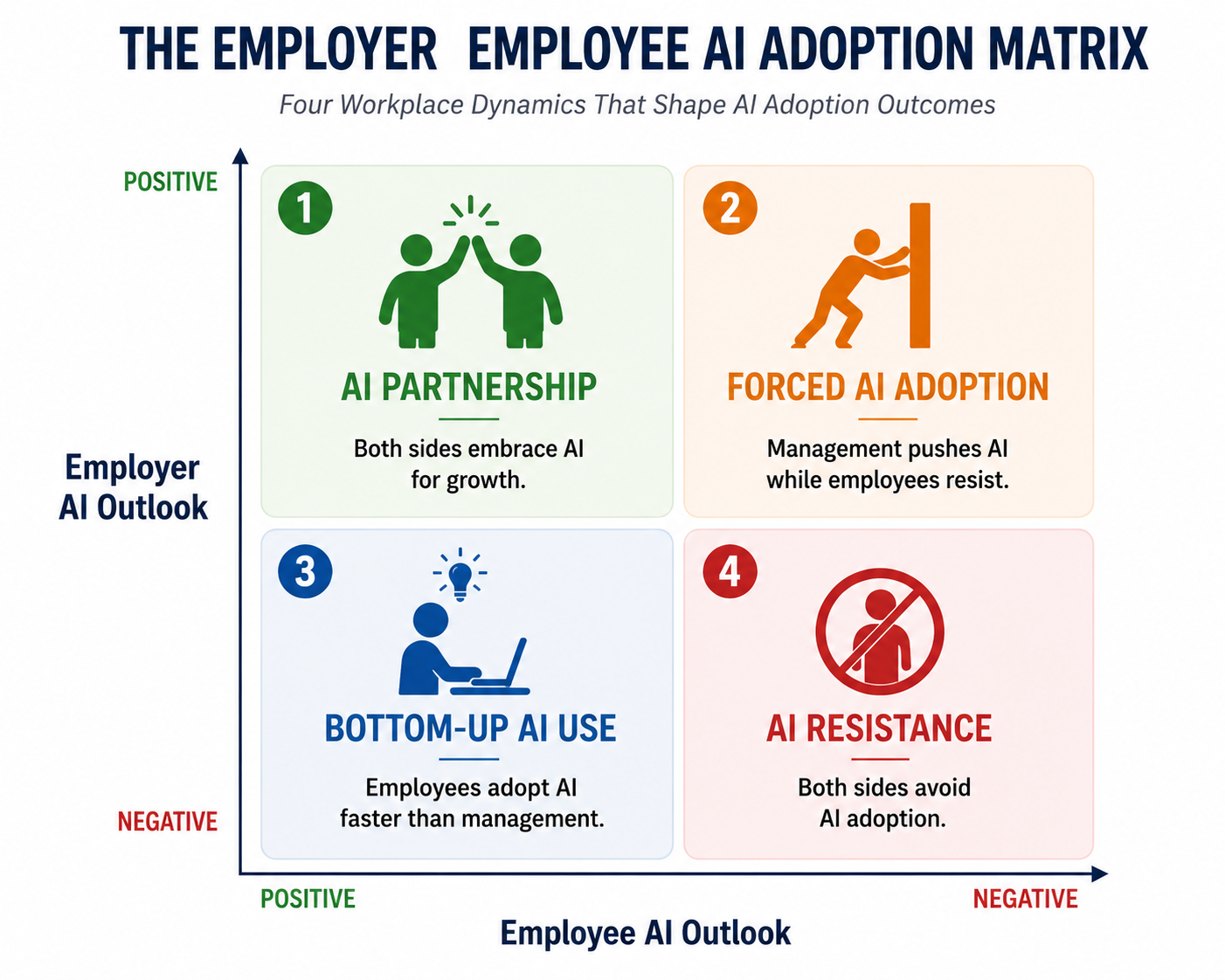
Quadrant 1 — AI Partnership
This is the ideal scenario.
Both employer and employee view AI as:
- a productivity multiplier,
- an operational advantage,
- and a long-term competitive tool.
Employees embrace AI because it helps them:
- execute faster,
- communicate better,
- and perform beyond their previous capability level.
Employers embrace AI because it:
- improves scalability,
- reduces repetitive work,
- and increases operational leverage.
In this environment:
- AI augments people instead of replacing them,
- productivity gains are shared,
- and organisations become leaner but more effective.
This is increasingly the model pursued by modern SMEs and agile professional firms.
Quadrant 2 — Forced AI Adoption
Here, employers aggressively push AI adoption while employees fear redundancy.
This creates:
- resistance,
- morale deterioration,
- distrust,
- and cultural friction.
Ironically, many employees do not resist AI because they dislike technology.
They resist AI because they fear becoming economically irrelevant.
This is particularly common in:
- telemarketing,
- administrative work,
- customer support,
- repetitive knowledge work,
- and operational processing roles.
In many organisations today, the biggest barrier to AI adoption is no longer the technology itself — but human incentives and organisational psychology.
Quadrant 3 — Bottom-Up AI Revolution
This may become one of the most underestimated developments within SMEs.
Management remains skeptical about AI adoption while employees quietly use AI tools independently to improve productivity.
Today, a junior employee can privately use AI to:
- generate reports,
- automate spreadsheets,
- improve writing quality,
- draft proposals,
- prepare presentations,
- or analyse information faster.
The employee becomes significantly more productive.
But the company itself may remain operationally outdated.
This creates a dangerous gap:
- employees become increasingly AI-enabled,
- while businesses fail to institutionalise AI capability.
Over time, adaptive employees may eventually outgrow the organisation itself.
Quadrant 4 — Stagnation & Decline
This occurs when both employers and employees resist AI adoption.
The organisation remains:
- manpower-heavy,
- process-heavy,
- and operationally slow.
Short term, operations may still function normally.
Long term, however, AI-native competitors begin to:
- operate faster,
- require fewer staff,
- scale more efficiently,
- and compete more aggressively on pricing and execution speed.
The danger of avoiding AI is often invisible initially — until productivity gaps widen significantly.
The Hidden Truth About AI Appreciation
One of the least understood aspects of AI adoption is that people perceive the value of AI differently depending on their original operating baseline.
This creates a fascinating paradox.
For example:
- someone operating at 50% capability who uses AI to achieve 80% performance experiences AI as transformational,
- while someone already operating at 70% who improves to 80% using AI may view AI as only incremental.
| Baseline Capability | With AI | Perceived Gain |
|---|---|---|
| 20% | 70% | Massive |
| 50% | 80% | Significant |
| 70% | 80% | Moderate |
| 90% | 95% | Marginal |
This explains why:
- junior employees often become highly enthusiastic about AI,
- while experienced professionals may appear more skeptical.
The weaker performer experiences empowerment.
The stronger performer experiences efficiency.
AI Compresses Competency Gaps
Historically, producing high-quality work required years of training and experience.
AI changes this dynamic.
Today, average workers can generate:
- competent reports,
- decent marketing copy,
- acceptable presentations,
- and reasonably professional communication.
This does not necessarily make them experts.
However, it significantly raises the baseline quality of output.
As a result:
- weaker performers improve rapidly,
- elite performers remain elite,
- but mid-tier knowledge workers face the greatest pressure.
AI compresses the middle.
The Real Shift: From Execution to Judgment
Before AI, much of professional value came from execution.
People were paid to:
- prepare,
- process,
- calculate,
- summarize,
- and organise information.
After AI, much of execution becomes increasingly commoditized.
The new differentiator becomes:
- judgment,
- strategic thinking,
- contextual understanding,
- decision-making,
- and accountability.
AI can generate answers.
But humans still decide:
- which answer matters,
- which risk matters,
- and which decision should ultimately be made.
Singapore’s Human Capital Challenge
This creates a unique challenge for Singapore.
Singapore’s economy has long depended on:
- educated professionals,
- structured corporate systems,
- and labour productivity advantages.
But AI reduces the scarcity value of many forms of knowledge work.
This raises uncomfortable questions:
- What happens when average workers can produce near-professional output?
- What happens when SMEs require fewer white-collar employees?
- What happens when AI allows a 5-person company to perform like a 20-person organisation?
The economy may gradually transition from:
manpower scaling
to:
intelligence scaling.
How CapitalGuru Uses AI as an Enabler
At CapitalGuru, AI is not viewed as a replacement for consultants.
It is viewed as a force multiplier.
The financing industry remains highly relationship-driven and judgment-based. SME owners do not simply require information.
They require:
- interpretation,
- financial structuring,
- lender matching,
- risk assessment,
- and strategic advisory.
AI helps CapitalGuru:
- prepare financing proposals faster,
- analyse client financials more efficiently,
- automate repetitive workflows,
- generate marketing content,
- support internal training,
- and improve operational efficiency.
This allows consultants to focus more on:
- relationship building,
- understanding business operations,
- solving financing challenges,
- and advising SME owners strategically.
Rather than replacing people, CapitalGuru aims to build:
AI-augmented consultants
Consultants who combine:
- human judgment,
- business understanding,
- market experience,
- and AI leverage.
The goal is not simply to work harder.
The goal is to achieve disproportionately higher output per consultant while improving advisory quality for SMEs.
Final Thoughts
The paradox of AI adoption is not whether AI will replace humans.
It is that AI may simultaneously:
- empower humans,
- reduce dependence on humans,
- democratize expertise,
- and redefine what human value means in the economy.
The future winners in a human capital economy may not simply be businesses with the best AI tools.
They may be the organisations that best combine:
- human judgment,
- AI leverage,
- operational adaptability,
- and aligned incentives between employers and employees.
In the AI economy, the most valuable workforce may no longer be the largest workforce —
but the most intelligently augmented one.