
What Is a Financial Gap?
Borrowing is often associated with financial difficulty. When an individual or business needs a loan, it is easy to assume they simply do not have enough money.
But a shortage of cash today does not necessarily mean someone is financially unhealthy.
Sometimes, the problem is simply timing.
A financial gap occurs when there is a mismatch between when money needs to be paid and when money is expected to be received.
The borrower has sufficient income, assets or future cash flow to meet the obligation, but those funds are not available at the exact time they are needed.
In such situations, borrowing can serve an important purpose: bridging the timing gap between cash outflow and future cash inflow.
Understanding this distinction is important because borrowing can either be a useful financial tool or contribute to a worsening debt problem depending on what the financing is being used to solve.
Financial Gap vs Financial Distress
In our previous article, Financial Distress: Understanding the Psychology Behind Compounding Debt, we discussed how financial pressure can change behaviour and cause debt to compound.
A financial gap is different.
The simplest way to distinguish the two is to ask:
Is there a clear and realistic source of repayment?
| Financial Gap | Financial Distress |
|---|---|
| Primarily a timing problem | Primarily an affordability problem |
| Future cash inflow is identifiable | Repayment source may be uncertain |
| Usually temporary | Often recurring or structural |
| Borrowing bridges two points in time | Borrowing may cover an ongoing deficit |
| Debt can be repaid when the expected inflow arrives | New debt may simply add to existing obligations |
| Financing may solve the problem | Additional financing may worsen the problem |
In simple terms:
A financial gap has an exit. Financial distress may not.
A Simple Example of a Financial Gap
Imagine an SME has completed a project and issued an invoice for S$200,000.
The customer is expected to pay in 60 days.
However, before receiving the S$200,000, the company needs to pay:
- S$60,000 in salaries
- S$50,000 to suppliers
- S$20,000 in rent and operating expenses
The business therefore needs S$130,000 today, even though S$200,000 is expected two months later.
The company may be profitable and its customer capable of paying, yet it still faces a temporary shortage of cash.
That is a financial gap.
The financing requirement exists because the company’s payment obligations occur before its cash inflow.
Financial Gaps Are Common in Business
Financial gaps are particularly common among SMEs because revenue and cash flow do not always occur at the same time.
A profitable company can still experience cash flow pressure.
For example, a contractor may complete work today but receive payment 60 or 90 days later. During that period, it still needs to pay employees, subcontractors and suppliers.
A trading company may need to purchase inventory before it can sell the goods and collect payment from customers.
A vehicle dealer may need to acquire inventory before the vehicles can be sold.
In each case, there is a timing difference between cash going out and cash coming back in.
Financing can bridge this gap.
Growth Can Actually Create a Financial Gap
One concept that business owners sometimes find counterintuitive is:
Growth consumes cash before it generates cash.
Imagine a company normally generates S$500,000 in monthly sales and suddenly secures new contracts that could increase sales to S$800,000.
This sounds positive.
However, the company may first need to:
- Purchase additional inventory.
- Hire additional employees.
- Pay suppliers.
- Increase production.
- Fund project expenses.
The additional revenue may only be collected several months later.
As sales increase, the company’s working capital requirement can increase as well.
A growing and profitable business can therefore experience a larger financial gap precisely because it is growing.
This is why profitability and liquidity are not the same thing.
Financial Gaps Also Affect Individuals
The same concept applies to individuals.
Suppose someone has sold a property and expects substantial sale proceeds upon completion.
Before completion, however, they require funds for another legitimate financial obligation.
There may be sufficient assets to repay the borrowing, but those assets have not yet been converted into cash.
Other examples may include waiting for:
- Property sale proceeds.
- Investment maturity.
- Contractual payments.
- Insurance proceeds.
- Other identifiable future receipts.
The key question is therefore not simply:
“Does this person need money?”
The more important question is:
“What event will repay the money?”
The Importance of a Clear Exit Strategy
A properly structured financial gap should have a clear exit strategy.
Before borrowing, the borrower should be able to identify:
- Where the repayment money will come from.
- When the money is expected to arrive.
- How reliable that source of repayment is.
- What happens if the expected repayment is delayed.
For example:
Borrowing requirement: S$100,000
Purpose: Fund supplier payments
Repayment source: S$150,000 customer receivable
Expected collection: 60 days
Financing tenure: 90 days
There is a logical relationship between the financing requirement and its repayment source.
The loan bridges a temporary timing mismatch rather than creating an indefinite liability.
Matching Financing to the Financial Gap
The structure of financing matters just as much as the amount borrowed.
Different financial gaps require different solutions.
| Financial Gap | Possible Financing Solution |
|---|---|
| Waiting for customer invoices | Invoice financing / factoring |
| Purchasing goods for resale | Trade financing |
| Temporary working capital mismatch | Working capital facility / overdraft |
| Waiting for property completion | Bridging financing |
| Purchasing inventory for resale | Inventory / floor stock financing |
| Acquiring productive equipment | Equipment financing / Hire Purchase |
The objective is to match the financing structure and tenure to the underlying cash flow cycle.
Using expensive short-term financing for a long-term requirement can create unnecessary repayment pressure. Likewise, taking a long-term loan for a very short funding requirement may be inefficient.
When Borrowing Makes Financial Sense
Borrowing can make financial sense when three conditions are present.
1. There Is a Clear Purpose
The borrower understands exactly why the money is required.
Instead of simply saying, “I need more cash,” the borrower should be able to identify the requirement clearly.
For example:
“I need S$100,000 to pay suppliers while waiting 60 days for S$150,000 of confirmed receivables.”
2. There Is a Clear Repayment Source
The borrower knows where the money to repay the facility will come from.
This could include customer receivables, sale proceeds, contractual payments or operating cash flow.
3. The Economics Make Sense
Borrowing has a cost.
The economic benefit created by the financing should justify that cost.
For example, if S$100,000 of financing allows a business to complete a transaction generating S$25,000 in gross profit while financing costs S$3,000, the facility may make commercial sense.
The question should therefore not simply be:
“What is the interest rate?”
It should also be:
“What economic benefit does this financing allow me to capture?”
When a Financial Gap Becomes Financial Distress
The boundary between a financial gap and financial distress is extremely important.
A temporary gap can become distress when the expected repayment source repeatedly fails to materialise.
Warning signs include:
- Receivables repeatedly being delayed.
- Loans being rolled over continuously.
- New loans being used to repay old loans.
- Interest being funded through additional borrowing.
- No identifiable event capable of fully repaying the debt.
- Monthly expenses consistently exceeding income or cash generation.
At this stage, the borrower is no longer simply bridging timing.
The borrower may be financing an underlying deficit.
Additional borrowing can then make the situation worse rather than solve it.
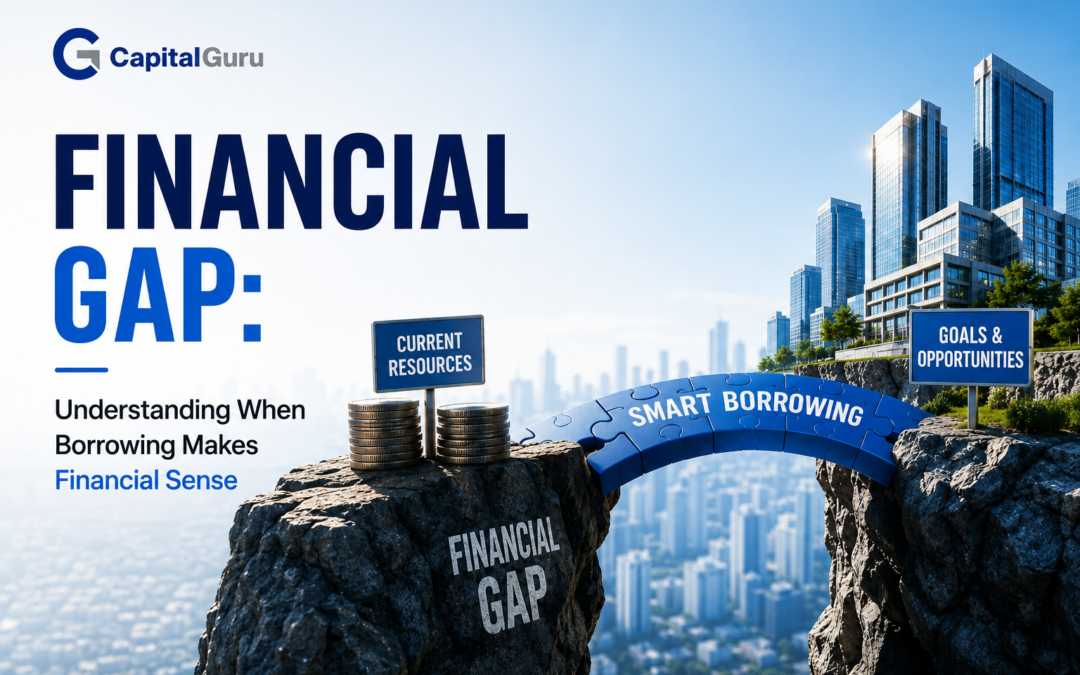
Financing Should Build a Bridge, Not Extend the Road
One useful way to think about borrowing is as a bridge.
On one side is today’s cash requirement.
On the other side is tomorrow’s identifiable cash inflow.
Financing connects the two.
A properly structured facility allows the borrower to cross that temporary gap.
But a bridge needs another side.
If there is no identifiable repayment source, additional financing may simply extend the road without solving the underlying problem.
That is the fundamental difference between using debt strategically and using debt merely to postpone financial difficulty.
Key Takeaways
A financial gap is not necessarily a sign of financial weakness.
Individuals and businesses can be profitable, solvent and financially healthy while still experiencing temporary cash flow shortages.
The key distinction is whether there is a credible and identifiable repayment source.
When borrowing bridges a genuine timing mismatch, financing can improve liquidity, support growth, fund transactions and prevent unnecessary disruption.
But when borrowing is repeatedly used without a clear repayment source, a financial gap may already be turning into financial distress.
The question borrowers should therefore ask is not simply:
“Can I get a loan?”
It is:
“What exactly will repay this loan?”
If that question has a clear answer, borrowing may be an appropriate financial tool.
If it does not, taking on additional debt deserves much greater consideration.
Financial Gap vs Financial Distress: Two Different Problems
This article is Part 2 of our discussion on financial health.
In Part 1: Financial Distress – Understanding the Psychology Behind Compounding Debt, we explored how financial pressure changes decision-making and why borrowers can become trapped in a cycle of increasing debt.
Here, we have explored the other side of borrowing: situations where an individual or business genuinely needs financing despite having a viable source of repayment.
The distinction can be summarised simply:
Financial distress requires recovery.
A financial gap requires a bridge.
Knowing which situation you are facing is often the first step towards choosing the right financing strategy.
How CapitalGuru Can Help
At CapitalGuru, we believe the first question in financing should not simply be how much you can borrow.
It should be why the financing is required and how it will ultimately be repaid.
For SMEs, this means understanding the operating cycle, receivables, inventory requirements, existing facilities and future cash flows before determining an appropriate financing structure.
By identifying whether a funding requirement represents a temporary financial gap or a deeper financial issue, businesses can make more informed borrowing decisions.
The right financing should not merely provide cash today.
It should provide a clear bridge to tomorrow’s cash flow.